
Include Cleaning in Your Nightly Rate: Pros and Cons

If you’re trying to decide whether to include cleaning in your nightly rate, the real question is simple: will a bundled price help you book faster without cutting too deeply into profit? For most smaller Hampton Roads rentals, bundling wins on guest appeal. For larger homes or higher-cost turnovers, a separate cleaning fee still does the better job.
Quick overview: what “include cleaning in your nightly rate” actually means
Airbnb says hosts can either charge a separate cleaning fee or build cleaning costs into the nightly price. That means you have two ways to recover the same expense. You either collect it once per reservation as a line item, or you spread it across each night of the stay.
What this means in practice: this is not just an accounting choice. It changes how guests see your listing, compare your price, and decide if your place feels fair.
The move that works is to base the decision on three things: your average stay length, your actual turnover cost, and how nearby listings in Virginia Beach, Norfolk, Chesapeake, Portsmouth, Suffolk, Hampton, and Newport News present pricing.
How guests see the price first
Airbnb’s pricing display has changed guest behavior. According to Airbnb, total price now matters more because search visibility and booking appeal are tied to how your full cost compares with similar listings nearby. A separate cleaning fee still shows up in the booking flow, and a high fee still causes second thoughts at checkout.
Here’s how to use it: think like a guest scanning options in Hampton Roads for a two-night stay. A lower base rate with a heavy cleaning fee looks cheap at first, then expensive later. A bundled rate looks cleaner and more hotel-like from the start.
That simplicity matters, especially if your property competes with hotels and short-stay rentals near the Oceanfront in Virginia Beach or event-driven stays in Norfolk.
Short stays vs. long stays
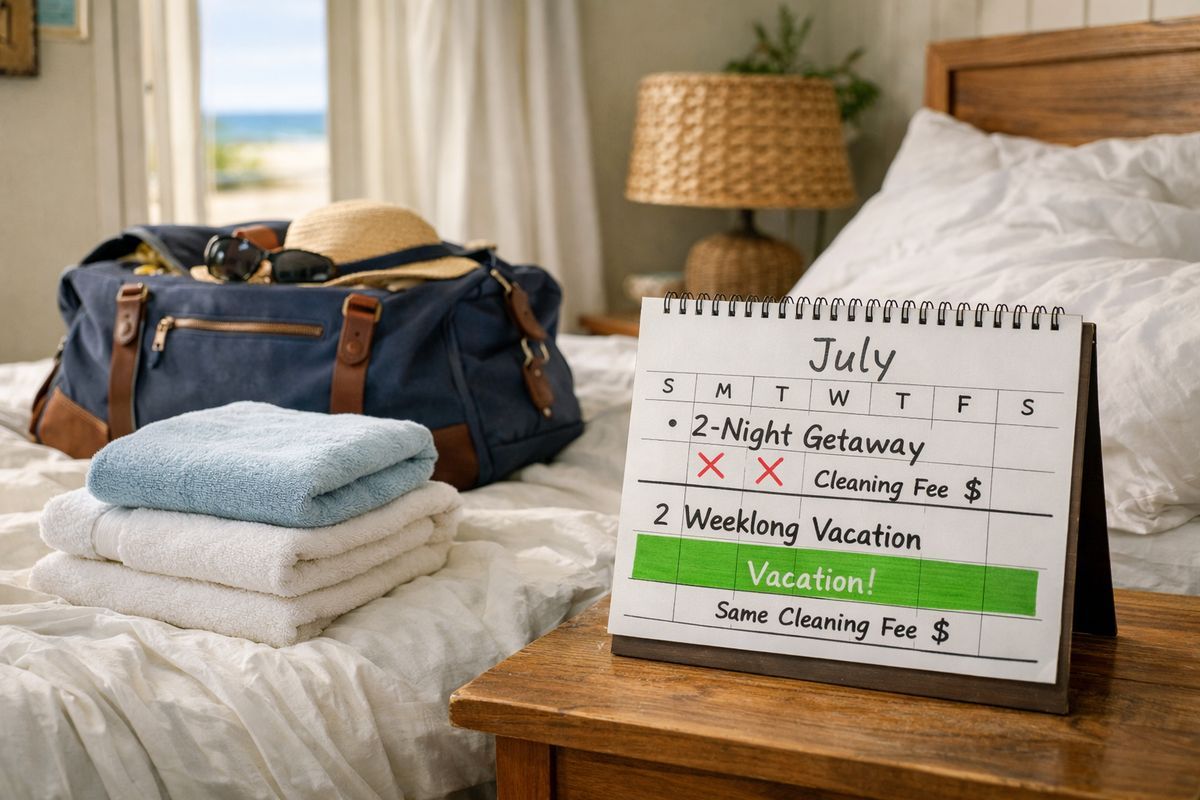
A 2024 Breezeway article explained the core problem clearly: one-time cleaning charges hit short stays hardest because the full amount lands on one- and two-night bookings. A $150 cleaning fee on a two-night stay adds $75 per night in real guest cost. On a seven-night stay, that same fee barely moves the needle.
What this means in practice: bundling cleaning into the nightly rate helps most if your calendar depends on weekend bookings, one-night gaps, or shorter business travel stays. That’s common in Hampton Roads, where travel patterns often shift around military moves, family visits, and local events.
But longer stays flip the math. If you spread cleaning across every night, a five- or seven-night guest ends up paying more than necessary. The single action here is to check your average length of stay. If most reservations are under three nights, bundling deserves serious consideration.
Total-price competitiveness in your market
A 2026 Guesty guide recommends benchmarking against at least 10 similar listings in your own area instead of using national averages. That advice is dead on. A pricing model that works in one market falls apart in another.
In Hampton Roads, guests compare your rental against hotels, beach rentals, and nearby short-term stays across several cities, not just your exact block. If nearby hosts already lean toward all-in pricing, your separate fee stands out in the wrong way. If separate fees remain common, bundling can push your nightly rate above local expectations.
The practical step is simple: compare total guest cost, not just headline rate. That tells you whether your listing feels competitive in the real market, not just in your spreadsheet.
Revenue recovery and margin protection
A 2026 AirROI analysis of 685,000 U.S. listings found that listings with cleaning fees often out-earned no-fee listings when the fee stayed in a reasonable range. That matters because cleaning is a fixed turnover cost, not a vague extra. Labor, laundry, supplies, inspection time, and restocking all count.
Here’s the catch: bundling can simplify revenue collection, but it also blurs the true cost of each turnover. If your cleaning cost jumps when guests leave heavy laundry, sand, pet hair, or extra trash, a separate fee protects margin more precisely.
This is also where operations matter. If you’re still estimating turnover by guesswork, start by learning what a proper post-stay clean actually covers. Once you know the real scope, your pricing decision gets much easier.
Property size and cleaning complexity
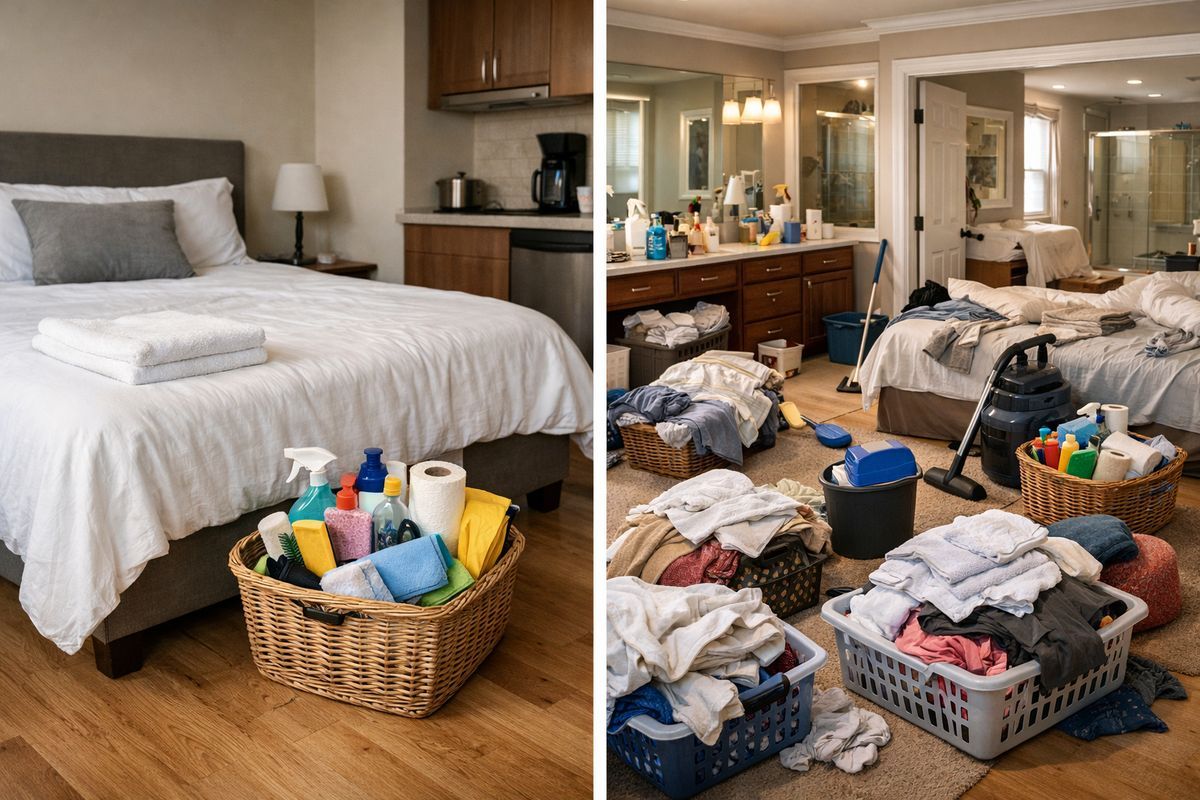
AirROI’s 2026 data showed how sharply cleaning fees rise with size. Studios averaged about $83, while 6+ bedroom homes reached about $458 per stay. That gap tells you everything you need to know.
Small units are easier to bundle because cleaning cost stays more predictable. A studio, condo, or small guest suite in Hampton or Newport News usually has a tighter turnover routine and fewer surprise labor hours. A large family home in Chesapeake or Suffolk does not. More bathrooms, more beds, more linens, more floor space.
The move that works is to match pricing structure to cleaning predictability. If your turnover time is consistent, bundling makes sense. If each clean changes with occupancy and wear, keep the fee separate.
Booking conversion and guest trust
Airbnb warns that guests scrutinize cleanliness more when a separate cleaning fee appears as its own charge. That reaction makes sense. Once guests see a line item labeled cleaning, every missed crumb feels personal.
Bundled pricing reduces that friction. It feels simpler, more natural, and more in line with hotel pricing. But there’s a limit. If the higher nightly rate pushes you above local comps, guests stop clicking before they even reach checkout.
Trust comes from clarity. If you charge separately, explain what the fee covers. If you bundle, make it clear that professional turnover is built into the rate. For hosts trying to tighten operations, it also helps to review what has to happen after every checkout, because guest trust depends on consistency, not just pricing format.
Flexibility for seasonal demand and dynamic pricing
A 2025 Bnbcalc pricing guide noted that seasonal swings change how cleaning costs feel to guests. In slower periods, lowering a separate fee can help stimulate bookings without forcing a permanent cut to your base nightly rate. In peak demand, that same fee becomes easier to absorb.
What this means in practice: a separate cleaning fee gives you cleaner control across changing seasons and stay lengths. Bundled pricing is less flexible because every rate adjustment affects all nights equally.
Bundling still works, but only if you support it with smart minimum-night settings or dynamic pricing. That’s especially true in Virginia Beach during heavier travel windows, where one-night demand and longer beach stays behave very differently.
Comparison against hotels and alternative stays
Hotels bundle housekeeping into the room rate. Guests know that, and guests compare your listing against that standard even if your turnover demands are far higher.
That’s the strongest argument for including cleaning in your nightly rate. A simple, all-in structure feels familiar. It reduces friction and makes your listing easier to understand at a glance.
But vacation rentals are not hotels. Full kitchens, multiple bedrooms, laundry, and family-heavy use create a bigger reset between stays. If your property requires more labor than a hotel room, a separate fee is easier to justify operationally. The smartest move is to look hotel-simple on the guest side without ignoring rental reality on the cost side.
Managing expectations around cleanliness
According to Airbnb, cleanliness remains one of the most common reasons guests leave fewer than five stars. Pricing does not change that. It only changes what guests expect.
A visible cleaning fee raises the bar in the guest’s mind. A bundled rate lowers line-item tension, but it does not buy forgiveness for weak execution. If the home is not spotless, guests notice either way.
That’s why professional support matters. In Hampton Roads, busy hosts, families, and property owners often need cleaning that is custom to the property, not generic. E3R Cleaning uses a property-specific quote process and handles vacation rental turnovers, deep cleaning, and move-related cleaning with a trained local team. That makes cost planning much more accurate before you decide how to present cleaning in your rate.
Pricing and fee benchmarks to use before you decide
AirROI reported in 2026 that the average U.S. cleaning fee was about $188, while the median sat much lower at $75. That gap shows why averages can mislead you. Large homes pull the national number up fast.
For practical use, smaller units often land around $75 to $150 in guest-facing fees, while larger homes go much higher. Another 2026 summary reported that 89 percent of U.S. short-term rentals charged a cleaning fee as of April 2025, so separate fees are still common even after total-price display changes.
Use your own numbers first. Add cleaner pay, laundry, supplies, restocking, inspection time, and platform fees that touch the cleaning charge. Then compare that cost with nearby comps. If your actual turnover expense is stable and modest, bundle it. If it is high or uneven, separate it.
When you should include cleaning in your nightly rate
Include cleaning in your nightly rate if your unit is small, your turnovers are predictable, and your bookings lean short. This is the better choice for studios, one-bedrooms, guest suites, and compact beach or city rentals where guests compare quickly and book based on simple total pricing.
It also works well if your local competition already looks all-in, or if you want your listing to feel more like a hotel rate. The simplest version of this is a modest rate increase that absorbs cleaning without making your nightly price look inflated.
When you should keep cleaning as a separate fee
Keep cleaning separate if your home is larger, your laundry load changes a lot, or your average stay is longer. This is the stronger choice for multi-bedroom homes, family-heavy bookings, and properties where turnovers include more inspection, restocking, or deeper reset work.
It also works better when your main goal is accurate cost recovery. If your cleaning bill changes meaningfully from one stay to the next, a separate fee protects your margin without forcing you to overprice every night.
The verdict: which option wins for most hosts
For most hosts, including cleaning in your nightly rate is the better default when the property is small to mid-sized and short stays drive bookings. Simpler pricing converts better, feels fairer, and lines up with how guests compare options now.
A separate cleaning fee wins when turnover cost is high, variable, and tied to larger homes or longer average stays. That is the exception that deserves the fee.
So the decisive rule is this: if your cleaning cost is predictable and your listing competes on short-stay appeal, bundle it. If your cleaning cost is heavy and inconsistent, separate it.
What to try this week
Compare your current total price for a two-night stay and a five-night stay against three similar listings in Virginia Beach, Norfolk, Chesapeake, Hampton, Newport News, Portsmouth, or Suffolk. If your short stay looks overpriced because of a separate fee, bundling is probably the move that works. If your longer stay looks expensive because your nightly rate is carrying too much cleaning cost, keep the fee separate.
If you need reliable turnover support, deep cleaning, or move-in and move-out help anywhere in Hampton Roads, request a quote at https://www.e3rcleaning.com/booking-page/.